School starts this week at NYSID and next week at Parsons, so here’s the back to school video of a song that features light. A strange video from Mumford & Sons, the beautifully photographed Lover Of The Light.
Lighting Design Insights from the Author of Designing With Light and Fundamentals of Energy Efficient Lighting and Controls
School starts this week at NYSID and next week at Parsons, so here’s the back to school video of a song that features light. A strange video from Mumford & Sons, the beautifully photographed Lover Of The Light.
Last year the AMA issued Policy H-135.927 Human and Environmental Effects of Light Emitting Diode (LED) Community Lighting, which recommended, among other things, that LED outdoor lighting should have a CCT of 3000 K or below. The AMA made this recommendation thinking that lower correlated color temperatures contain less blue light, which can disrupt circadian rhythms.
Today the IES issued a Position Statement disputing that recommendation, noting that CCT
is inadequate for the purpose of evaluating possible health outcomes; and that the recommendations target only one component of light exposure (spectral composition) of what are well known and established multi-variable inputs to light dosing that affect sleep disruption, including the quantity of light at the retina of the eye and the duration of exposure to that light. A more widely accepted input to the circadian system associated with higher risk for sleep disruption and associated health concerns is increased melanopic content, which is significantly different than CCT. LED light sources can vary widely in their melanopic content for any given CCT; 3000 K LED light sources could have higher relative melanopic content than 2800 K incandescent lighting or 4000 K LED light sources, for example.
Follow the link to read the entire Position Statement. Blue light hazard, light’s impact on circadian rhythms and overall health, and related topics are a hot area of research. We’re learning more all the time, but we don’t yet know enough to apply circadian lighting to every situation. Outdoor and street lighting are among the areas where research is not yet conclusive.
Like other lighting technologies, the color or chromaticity of light emitted by an LED can shift over time. To address the challenge of developing accurate lifetime claims, DOE, together with the Next Generation Lighting Industry Alliance, formed an industry working group, the LED Systems Reliability Consortium (LSRC). A new LSRC report, LED Luminaire Reliability: Impact of Color Shift, focuses on chromaticity. The purpose of the new report is not to define limits for specific applications, but rather to enable a better understanding of how and why color shifts, and how that impacts reliability. Download it and take a look.
The CIE has issued a statement titled “CIE 2017 Colour Fidelity Index for accurate scientific use” in which they partially adopt the Rf fidelity metric of TM-30. Here are some of the details.
When the IES released TM-30-15 it seemed to be a wake up call for the CIE, who have understood the inaccuracies of CRI but haven’t been able to build the internal consensus to correct them. Two CIE committees soon began work, one on the issue of fidelity and one on other perception related issues. The committee that worked on fidelity (TC 1-90) has decided to adopt TM-30 Rf with a few minor changes to the calculation. They are calling this the CIE 2017 Color Fidelity Index, which will still be described as Rf, and are asking the IES to adopt the same changes to the calculation so that both Rfs are the same.
However, at this time there is no retirement date for CRI, even though they acknowledge that Rf is more accurate. The logic is a bit twisted. Since CRI is used for purposes other than the intended purpose, and since TM-30 doesn’t satisfy those purposes, we’re going to continue to mis-use CRI. Meanwhile, “replacement of the CRI will be a matter of future study and discussion.”
I’ll probably have more to say once I read the entire report. If you want to read the report yourself you can purchase it here.
As the co-chair of the IES Color Committee I am delighted (pun intended) to announce the publication of the Design Guide for Color and Illumination. The guide is the result of over five years of work by more than a dozen researchers, engineers, manufacturers, and designers from across the globe. Here’s part of the description on the IES site.
Color can be described using concrete values such as chromaticity coordinates, spectral power distribution, or others discussed later in this guide. However, one’s response to color can be much more personal and emotional—and therefore more difficult to quantify. This guide takes the reader from basic vision and color vocabulary, through methods of measuring and quantifying color, and culminates in the practical use of commercially available white light and colored lights. The definitions, metrics, and references discussed will assist in building a critical understanding of the use and application of color in lighting.
It is probably the best, most thorough discussion of light and color available today. Everyone interested in color, color perception, color rendering, and their relationship to light should read it. It will be available at the IES booth at Lightfair.
You may remember that in June of last year the American Medical Association (AMA) released a report called “Human and Environmental Effects of Light Emitting Diode (LED) Community Lighting.” The report made some noise in the general press because it supported the idea that blue light from blue-pump white LEDs contribute to disability glare and retinal damage.
In the lighting community there was a considerable amount of frustration and anger over the report for several reasons. First, there were quite a few references cited that were either hearsay, such as a New York Times article about Brooklyn residents who didn’t like their new LED street lights, or were irrelevant, such as several articles about the effect of skyglow on nesting turtles. The other reason was that there was not a single lighting designer or researcher on the panel. Overall, it was a poorly researched paper that didn’t deserve the attention it received.
Shortly after it was issued, the Lighting Research Center at RPI issued a response paper. On March 15 the authors of that paper held a webinar to further address the AMA report. A video of that webinar is now available. If you’ve got an hour, take a look.
The key takeaways regarding the hazard of blue light from LEDs and the report are:
Mark Rea and Jean Paul Freyssinier of the Lighting Research Center explain why lighting regulatory policies that combine efficacy and color rendering elements are fundamentally misguided, and how the industry could simply ensure that customers get both energy-efficient and quality light.
Source: CRI should never be used in efficacy regulations but a new lumen definition should (MAGAZINE)
Measuring and describing the brightness of colored LEDs is an increasingly important part of a lighting designer’s practice. They are used more often, and in more types of projects, than ever before. Yet, we don’t have an accurate method for understanding exactly how much light is being produced and how bright it will appear. It’s a problem that the lighting industry needs to solve, and soon.
The human eye does not respond to all wavelengths of light equally. We have the greatest response to the yellow-green light of 555 nm. Our response falls off considerably in both directions. That is, wavelengths of light do not contribute equally to our perception of brightness. The sensitivity curve of the human eye is called V(λ) (pronounced vee lambda) and is shown below.
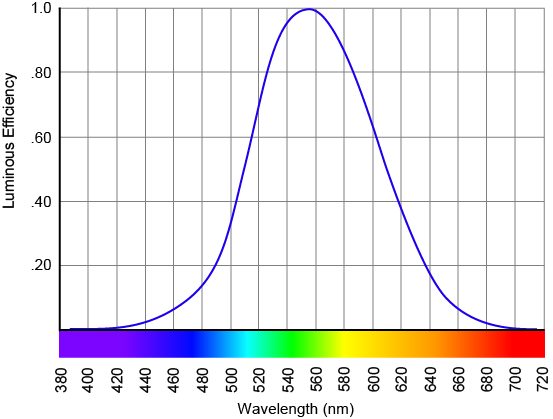
The definition of a lumen, the measurement of brightness of a light source, is weighted using V(λ) and essentially assumes that the light source emits light across the visible spectrum – in other words, it produces a version of white light.
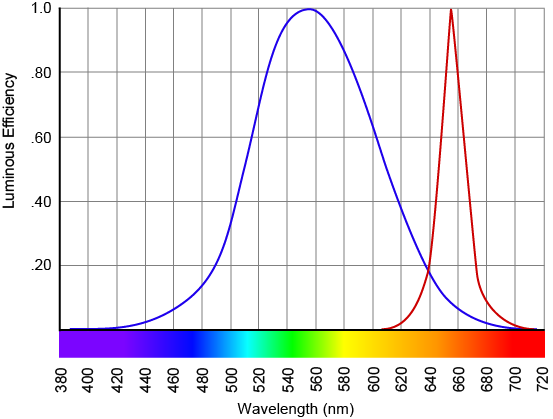
Light meters are calibrated to measure white light using V(λ) so that their measurement of brightness corresponds with our perception. Individual colored LEDs emit only a fraction of the visible spectrum, as shown below in the graph of V(λ) and the SPD of a red LED, and that’s the problem.
Light meters measure the light that the colored LEDs provide, of course, and this information is included on an LED fixture manufacturer’s cut sheets, but it often makes no sense. For example, an RGBW fixture I’ve arbitrarily selected reports the following output in lumens: Red 388, Green 1,039, Blue 85, White 1,498. Since brightness is additive, the output when all LEDs are at full should be 3,010 lumens. However the Full RGBW output is given as 2,805 lumens! That’s 7% lower than what we expect.
The essential problem is that the colored LEDs give the light meter only a fraction of the spectrum it’s designed to measure. The meter provides a result based on its programming and calibration, but the results are often nonsensical or at odds with our perception. This problem doesn’t affect only architectural lighting designers. Film and TV directors of photography and lighting directors also rely on a light meter’s accurate measurement of brightness in their work, and when using colored LED fixtures the light meter is likely to be wrong. In fact, even white light LEDs can be difficult to measure accurately because of the blue spike in their SPD.
For now, the only way to accurately assess the brightness of colored LEDs is to see them in use. Lighting professionals need to let manufacturers and others know that the current situation is not acceptable, and that an accurate method of measuring and reporting the brightness of colored LEDs is a high priority. Talk to fixture and lamp sales reps, fixture and lamp manufacturers, and decision makers at IES, CIE, NIST and other research and standards setting organizations. There’s a solution out there. We need to urge those with the skills and resources to find it to get going!
Here in New York City we have no stars in the night sky, just a dull orange glow. A new interactive atlas shows the global effects of artificial light on views of the stars from Earth.
Source: Light Pollution Masks the Milky Way for a Third of the World’s Population
If you missed IES Research Symposium III Light + Color you missed an exciting (for color geeks) few days. It would take too long to relate everything that was discussed, but here are some key highlights.
