Design Is A Process, Not Just A Product

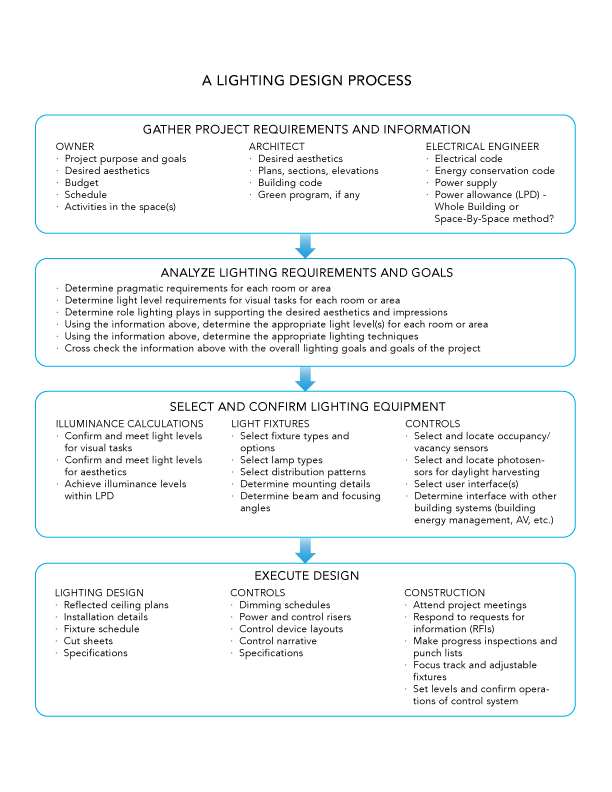
I often tell my students that design is as much a process as it is a product. Even so, they (and some of my clients) sometimes want to go from first meeting to finished design in one step. I suppose one could do that, but the result wouldn’t be a thoughtfully appropriate design, it would just be fixture selection. The difference lies in the early part of the design process where we gather information about the project and the expectations of the stakeholders, followed by an analysis of that information towards the stated goals of the project. Only after completing those two critical steps can we begin the work of putting the design together and executing it. Here’s one way of looking at the entire process.Lighing-Design-Process

Who Needs A Lighting Designer? Museums and Galleries!

A few weeks ago I gave a three-hour seminar on lighting museums and galleries to the graduate students in an art curating program at a university here in New York. Condensing everything I’d like to say into less than three hours was tough. The two big questions were what to include and what to leave out. I started with a quick overview of how to think about light and lighting before moving on to basic vocabulary and some common lighting techniques. Then, since LEDs are clearly the future, even when lighting art, I moved on to an overview of both color temperature and color rendering. I talked about reference materials such as the IES Lighting Handbook, intensity and brightness ratios, and other considerations before we moved into their gallery space to use their track light system for some demonstrations.

After the whole affair a faculty member, who sat in on most of the seminar, said he had hoped I would have spent much more time talking about how to use track lights and less time on unimportant issues like design, color temperature, and color rendering (!). I was respectful, but stunned. Focusing track lights is so complex that it requires extensive demonstrations? Understanding that with LEDs the color qualities of the light vary widely, and can only be properly selected when they are understood is unimportant information? Uhh…NO. Or, as my 20 month old niece says, “no no no no.”

Yes, five or ten years ago the default light source in museums was an incandescent or halogen lamp. The color temperature difference was minor and the color rendering of both was excellent. That’s not true today. Look at the cut sheet for any museum grade track light and you’ll see that you have a choice of several color temperatures and CRI values. If ANYONE needs to understand the qualities of light that must be selected when using LED fixtures, if anyone needs to understand the affect that color temperature and CRI have on how colors are perceived, it’s certainly people involved in displaying and lighting art. To me, that means the curators of exhibits and the lighting designers they hire.

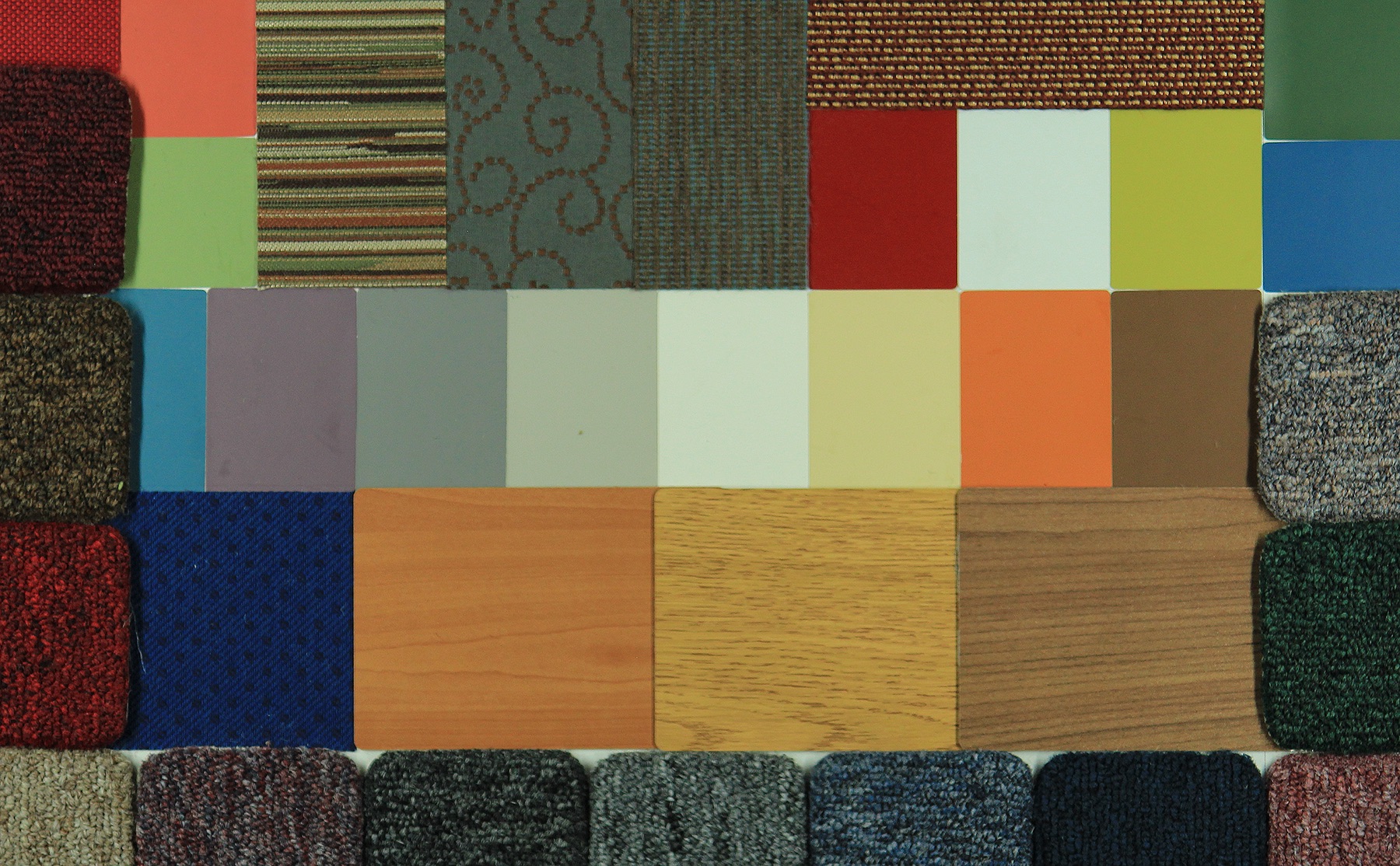
As I’ve discussed earlier, changing the color temperature of the light changes the color appearance of objects, as shown below.

Illuminated with Warm White Fluorescent Lamp
Illuminated with 3000 K light
Illuminated with Cool White Fluorescent Lamp
Illuminated with 4000 K light

The phenomenon of color consistency means that the shift in color appearance isn’t as great as one might expect or as these photos suggest, but the shifts are real. If you’ve ever bought a black garment only to discover later that it was actually dark blue you’ve experienced this shift. A similar thing happens when we compare a high CRI light source and a low CRI light source. If your work involves color perception this is basic and critical information.

Curators can be forgiven for not knowing much about this, but if they know nothing how can they collaborate with their lighting designer to show the art as they intend? Administrators and curators of museums and galleries – educate yourselves, then hire a lighting designer!

Who Needs A Lighting Designer? Schools!

Studio T+L is the theatre consultant on the theatre in a new school here in New York. During an early meeting with the architect I explained that I prefer to have the dimming and control system for the stage lighting also control the house lighting, so I’d like to schedule a meeting with the lighting designer to talk about coordinating our work.

I wasn’t surprised (although I was disappointed) to be told that the design team for this new school building doesn’t include a lighting designer. Who’s designing the lighting in the classrooms, offices, theatre and other spaces? It’s hard to say. The plan is that one of the architect’s lighting sales representatives will present them with a choice of light fixtures, the architect will select the fixtures, and the electrical engineer will lay them out and circuit them. Unfortunately, this is an all too common approach that results in mediocre lighting, at best. Here’s why…

For starters, it’s highly unlikely that the architect has a deep enough understanding of vision, visual tasks, current fixture technology, control technology, code requirements, and the lighting design requirements of educational facilities to thoroughly evaluate the lighting needs of the school and the various types of spaces that it holds. It’s much more likely that the architect is working with a possibly outdated rule of thumb such as, “Schools should be lit to 50 fc.”   The sales rep, even if he/she is capable, isn’t going to invest any time or effort in a deeper evaluation of the school’s needs because the fixture sale (not good lighting) is the goal, so meeting the architect’s requirements is all that he/she has to do. The electrical engineer is simply implementing the architect’s instructions. He/she is given the selected fixtures and told to arrange them to provide 50 fc, and make sure to cover the code requirements.   What’s missing is any thought about how the spaces will be used and the actual needs of the occupants .

I believe that design is as much a process as it is a product.  A lighting designer would not assume that all school lighting is the same, and that as long as there’s enough light the lighting will be good enough. A lighting designer would talk to the school about their present facility, and about the good and bad aspects of the current lighting. The lighting designer may consult one or more of the available guides to quality lighting design for schools such as ANSI/IES RP-3-13 Lighting for Educational Facilities, and would look for opportunities to include daylighting as one element of the overall lighting design. A lighting designer would look at the sustainability and energy efficiency aspects of the lighting system and factor that information into the overall design. A lighting designer would take the time to understand how various types of classrooms are used, and would lay out fixtures and select controls accordingly.

I’m sure that none of this is happening on this school project.

And, not just any lighting designer will do. It behooves architects to have some understanding of the lighting needs for the building types they design to make sure the lighting designers they hire doing their job.  For example, my classes at Parsons School of Design in Manhattan are held in a building that is less than five years old.  It  that was designed by a prominent architect. However, the classroom I was in last semester had terrible lighting.  The room has two rows of direct-indirect pendant fixtures. The uplight and downlight components are controlled together, and all of the fixtures are controlled by one dimmer, so all of the lighting in the room works as one. The problem? The projection screen is bathed in light that washes out the image, and there’s no way to dim or turn off only the fixtures that affect the screen. There are lighting controls by the door, but none by the instructor’s computer station, so I find myself walking back and forth across the room to make adjustments to the light as I constantly balance my students’ need to see the screen with their need to see their notebooks. This is a rookie mistake, and any experienced designer worth his or her salt should have immediately seen the potential problem and selected fixtures, a layout, and controls to avoid it, but it didn’t happen.

So, who needs a lighting designer? Schools and the architects who design them.

Light + Color Symposium Registration is Open

Registration is now open for the IES Research Symposium III, Light + Color.  I’m on one subcommittee that’s coordinating the symposium and have sat in on organizing meetings, and I can assure you that it will be a very informative three days.  The IES describes the symposium, saying “This international lighting research and application symposium will draw on the talents and expertise of the researcher, the technologist and the design professional to better understand the growing role of color in lighting from the standpoints of color vision, color perception, color preference, color metrics and color technology.”  The symposium will be April 3-5 in Gaithersburg, MD and will include tour of the color labs at NIST.  Register here.  See you there!

NEMA Misrepresents IES TM-30

On November 12 the National Electrical Manufacturers Association (NEMA) published a position paper on IES TM-30-15. The document is here. It seems to be a willful misunderstanding and misrepresentation of TM-30. Here’s how…

The paper opens with NEMA’s support of an improved color metric but then goes on to say that “NEMA opposes any mandatory reporting or performance requirements for IES-Rf or IES-Rg.” This is a strange opening since neither the IES, in general, or TM-30, in specific, is proposing mandatory requirements. In fact, the IES’s own position paper on this states that “As with any IES Technical Memorandum, TM-30-15 is not a required standard.” So the paper begins with alarm about a non-issue.

Next, it says that, “Any single-number fidelity measure (such as Ra or the new Rf) that averages the results of many colors in a light source could possibly have a high numerical value and yet perform poorly with some specific colors.” Exactly. That’s the problem with CRI Ra, only a single number is reported. The great advantage of TM-30 is that in addition to the average fidelity value Rf, the calculation tool allows designers to see 1) the fidelity within color groups, called Hue Angle Bins, that encompass the entire color space 2) the direction of hue shift (if any) as displayed in the Color Vector Graphic, and 3) the Rf for each of the 99 Color Evaluation Samples (CES). Far from being a single value, as with Ra, TM-30 provides designers with layers of additional information about the performance of the lamp in question.

In the next paragraph we are told “The IES-Rg metric can have a value greater than 100 and yet saturation might be lower than the reference light source for certain colors.” Right again, but in a misleading way. As with color fidelity, TM-30’s evaluation of color gamut is layered. Rg represents the average shift in saturation of the 99 CES. If a specifier wants deeper information it is available in the calculation tool as 1) a CES chromaticity comparison that plots the CES under both the reference illuminant and the test source so that one can see the shift 2) a graph showing the change of chroma by Hue Angle Bin.

The entire third paragraph complains that if Rf is 100 there can be no increase or decrease in Rg – saturation is held at 100, too. This is like pointing out that the problem with taking a bath is that you get wet and soapy. The interrelation between Rf and Rg is a feature, not a bug. When the fidelity index of a light source matches it’s reference then OF COURSE they will produce the same saturation of colors. If one wants to purposely increase or decrease saturation the only way to do so is to use a light source that is NOT an exact match to the reference source, and hence one that has a lower fidelity value. The relationship between Rf and Rg are shown as a graph in the calculation tool to help designers visualize the values that the tool calculates. That’s a good thing.

Finally, the paper concludes with “It is premature to consider IES TM-30-15 as a mandatory requirement or regulation because the metrics are likely to evolve.” As I said at the beginning, this is a non-issue.

The IES developed and issued TM-30 because CRI does not consistently and accurately represent the color rendering of many light sources, especially narrow band emitters like LEDs. This issue is well known and completely accepted by the industry, including the CIE. (A list of CRI’s shortcomings is included in the latest edition of the IES Lighting Handbook.) The IES position is that TM-30 “has been developed for the benefit of the lighting community to provide: (a) a more accurate assessment of color fidelity; (b) an additional, complementary assessment of the influence of the preferred color appearance of objects (related to color gamut); and (c) more detailed information about the rendition of specific colors.“ and goes on to say that, “the issuance of TM-30-15 will enable the international lighting community to carefully evaluate it, providing a path leading to improved standards and design guidance. Technical analysis and feedback regarding the method described in TM-30 will be critical to continued development and standardization of color quality metrics.” In other words, “We think this is a good tool. We’re publishing it so that other concerned parties can evaluate it. We hope that this will trigger the acceptance of TM-30 or the development of another tool.”

Clearly NEMA as an organization, or members of their Lighting Systems Division, has a problem with the IES issuing TM-30, but the position paper is a red herring. It stirs up alarm over TM-30 becoming a requirement or regulation when the IES has noted that isn’t the purpose of a TM, and attempts to point out shortcomings that actually belong to CRI, not to TM-30. I don’t know about the politics involved here, but I do know that this paper should be read with skepticism.
Who Needs A Lighting Designer?

No I’m not begging for work (although I am available for weddings and bar mitzvahs). At the beginning of every semester I ask my interior design students (especially at Parsons, where the class is an elective) why understanding lighting design is important to them. They tell me that lighting design is important for setting the mood or atmosphere, that lighting affects the appearance of materials and finishes, and that light is an important element in the overall design of any space. Good job!

But, as we move through the semester they often say that there’s so much to know and ask if interior designers, architects, and electrical engineers really know all of it. If not, why do only 10% of construction projects have a lighting designer? Why isn’t a lighting designer assumed to be part of a design team just like an electrical or mechanical engineer?

So I did a little research. According to the DesignIntelligence ranking of the top five interior design programs, only three undergraduate and one graduate program require a semester long course in lighting design. It turns out that I’m in a fairly unique situation in that my undergrad interior design students at Pratt are required to learn about lighting design.

What about architects? According to Architectural Record’s ranking of the top ten undergraduate and graduate architecture schools, only one grad program, and zero undergrad programs, require a course in lighting design! So, at least in the U.S., we shouldn’t expect interior designers or architects to create more than utilitarian lighting because they’re not educated in the practice of lighting design.  Yes, many care quite capable of laying out a lighting plan that meets code requirements but we should remember that codes set minimum requirements for safety and energy efficiency. Codes have nothing to say about appropriateness for the application much less anything to do with aesthetics of the space or the interaction between light and materials.

So what do I tell my students? In the same way that there’s a difference between a decorator and an interior designer, there’s a difference between someone who can “do lighting” and a lighting designer. The differences are many, actually, and include academic education and training, continuing education, range and depth of experience, and a focus on the practice lighting design as a profession and a livelihood, not as an ancillary service. I tell them that it’s important for them to be able to speak the lighting designer’s language and to understand the interaction between light and materials because lighting can have such a strong effect on their work. I tell them that they may find themselves lighting some of their own projects and I hope my class prepares them for that. In the end I also tell them I’m sure they’ve learned that the best lighting designs are created by a professional lighting designer. If they want the best for their clients and their work, it’s worth the extra fee and worth talking to the client about what a lighting designer can do to support and enhance the project. Everyone needs a lighting designer, they just don’t know it.

CRI Inches Forward

The CIE’s Color Rendition Index (CRI) has long had several known weaknesses including outdated components of the calculations, a limited set of color samples, and standard reporting of only one piece of data (the average color distortion of the first eight colors, known as the General Color Rendering Index or Ra). After more than a decade of stalemate it seems that the IES’s TM-30 has convinced the CIE to make another attempt at updating CRI.

In a recently released position statement the CIE announced that the CRI technical committee (TC 1-90) has taken up the problem again and is expected to write a technical report on a new, improved color fidelity metric that can update CRI before the end of 2016. They will use TM-30 Rf as the basis for their work. Another committee, TC 1-91, will write a report on a color preference metric in the same time period.

This is both good and bad news. CRI is the international standard for measuring and reporting light source color rendering. It is long overdue for an update, and I’m glad to see the CIE working on it. On the downside, the press release makes it sound as though 1) parts of TM-30’s Rf may be incorporated, but the CRI fidelity metric will be a new creation 2) we may see the addition of a color preference metric but TM-30’s gamut metric Rg apparently isn’t being considered. The biggest reason that this is a concern is the amount of time it takes to create the work, gain internal consensus, approve the work, and gain organization approval – all of this before the work can be released to the larger lighting community for consideration. I think it is extremely optimistic to think that the two committees can write meaningful reports on these issues in only one year, especially given the difficulty they’ve had reaching consensus in the past.

I would much rather see the CIE committees study TM-30 and report on its strengths and weaknesses before deciding that it won’t work and they should start over. Adopting or modifying TM-30 can happen much quicker than developing one or more new metrics. TM-30 took three years to develop and the industry shouldn’t have to wait another three years for an updated metric that has the CIE’s approval.

Xicato Publishes IES TM-30-15 Results for its LED Modules

In a first (as far as I know) LED manufacturer Xicato has published TM-30 results for some of its modules alongside the CRI results for Ra and R9.  Menko de Roos, CEO of Xicato, says “At Xicato we are very supportive of TM-30-15 overall and recognize the need for an improved metric system along these two dimensions.”  You can read the full press release and find links to the results here.

I’m excited to see this greatly improved color rendering metric being used by a major manufacturer, and hope to see more manufacturers releasing TM-30 results soon.  If you still haven’t looked into TM-30 there is an increasing number of resources available to you.  TM-30 is available for purchase here. You can also view the recording of a webinar sponsored by the DOE and the IES and presented by two members of the IES Color Rendering Subcommittee, Michael Royer and Kevin Hauser.

Use of LED Lamps To Improve Health

Today’s New York Times has an article on several manufacturers’ new LED products that are intended to improve wakefulness, sleep, focus, and other aspects of daily life and health. The article appears on both the business and technology pages, but not on the health page, and I think that’s appropriate.  Although there are testimonials by the consumers of some of these products, there’s no discussion about any peer reviewed science behind them.  In fact, about two-thirds of the way through the article the author finally gets to the fact that, “Researchers are still determining how spectrum and intensity of light affect the brain.”  So, the article is an uncritical look at new LED products that make health claims.  We shouldn’t rely only on the claims of the manufacturers, though – remember the claims of 100,000 hour lifetimes for LED lamps?

I’m not saying that we know nothing about how light affects us, because we know quite a bit.  The question is, “Do we know enough to properly and safely integrate that information into our design practice?” and there things become uncertain.  So, before accepting the claims of manufacturers, or making the same claims to clients, it’s important for designers to be up to date on the current state of research and to understand the strength of the findings, as well as how (and if) those findings can be folded into a design.

There are a few web sites that I find useful for keeping up to date.  The first is the Health and Vision page of the Lighting Research Center’s web site, which has links to many of their recently published research papers.  The second is the Research page of USAI Lighting’s web site.  This page provides links to a mix of newspaper articles and scholarly publications on a variety of topics connected to LED lighting.  The third is the Research page of the IES web site.  Finally, members if the IES can  download copies of Leucos, and non-members can purchase copies.

LEDs continue to revolutionize the lighting industry.  Most manufacturers have ended  research and development for incandescent and fluorescent products. OLEDs are increasing in efficacy and prices are dropping, while new technologies (such as light emitting plasma and quantum dots) are on the horizon or already here. To preserve their client’s money, the occupant’s health and safety, and their own reputations, designers need to make sure that they don’t get swept up in the possibilities that are marketed to them before the facts are in.