A Brief History of TM-30

Next Wednesday I’ll be giving a presentation on LP-30 at LEDucation (hope to see you there!), and in preparing for it I’ve been reflecting on how far we’ve come in our understanding and evaluation of color rendering.


The Color Rendering Index (CRI) was published by the International Commission on Illumination (Commission Internationale de l’Eclairage or CIE) in 1965, primarily to deal with the problem of poor color rendering by early fluorescent lamps.  It was a rather simple system that evaluated a light source by mathematically comparing the appearance of eight colors under the test light in question to their appearance under a standardized reference light source of the same correlated color temperature (CCT).  It used the latest models of human vision, returned a single value that was easy to understand, and was quickly adopted by the industry.


CRI is a fidelity metric, meaning that the CRI value represents how closely the test light matches the reference light.  Since this was the only system endorsed by a standards setting body, and became ubiquitous in our industry, many people came to believe that color rendering and fidelity were the same thing.


Perhaps unsurprisingly for a new system, errors were found and corrected in the 1974 update.  The next update, in 1995, made only typographical corrections to the document.  Science has, of course, progressed since then with many components of the CRI calculation being withdrawn from use by the CIE as improved components were developed.  The problems were well known and documented.  For example, the IES Lighting Handbook 9th Edition, published in 2000, included a brief discussion about this, and the 10th Edition, published in 2011, included a table describing nine limitations of CRI.  Unfortunately, for what seem to be political, not scientific, reasons CRI hasn’t been updated since.  In fact, as late as 2017 CIE 224:2017 continued to recommend CRI for general use.


The “limitations” of CRI were exacerbated by LEDs, whose distinctive spectral shape frequently resulted in CRI values at odds with observed color rendering.  By the mid-2010s the mismatch between CRI values and observations, combined with the clear trajectory LEDs were on to exceed the efficacy of other light sources and become the dominant source, meant something had to change.  Since it was clear that CIE wasn’t going to update CRI, members of the IES Color Committee formed a Task Group to evaluate the issue and develop a completely up to date, color rendering metric drawing on the best ideas other researchers had proposed over the years.  The result, in 2015, was ANSI/IES TM-30 Technical Memorandum: IES Method for Evaluating Light Source Color Rendition, or TM-30.


Initially, we thought that TM-30’s Rf (Fidelity Index) and Rg (Gamut Index) would be the key metrics, because they were similar to the CRI-GAI (Gamut Area Index) system developed at Rensselear Polytechnic Institute as an improvement on CRI alone.  Light sources that met certain values were described as Class A under this system.  TM-30 produces many more measurements, 149 in fact. We didn’t know what they would mean or how they could be used, but thought the additional information would, at a minimum, be useful to researchers.


However, by 2018 several studies had been published with exciting results showing that by using four metrics instead of two (Rf, Rg, Rf,h1 (fidelity of red), and Rcs,h1 (chroma shift of red) TM-30 would allow users to evaluate a light source not only for fidelity, but for preference and vividness as well.  The analysis of the studies became TM-30’s Annex F, with the explanation of Preference (P), Vividness (V), and Fidelity (F) provided in Annex E, and the TM-30 reports were modified in 2020 to display the four key metrics and the PVF results.  This was a huge improvement over CRI and gave designers the ability to tailor their color rendering goals to the needs of the project and the occupants.  For example, projects such as hospitality benefit from a light source that renders colors in a way that is preferred vs high fidelity.


In the meantime, CIE did a more thorough evaluation of Rf (specifically their version of Rf as defined in CIE 224:2017) and in January of 2025 CIE PS 002:2025 recommended the industry transition away from CRI to Rf.  The IES, on the other hand, takes the position that it doesn’t make sense to simply replace one fidelity metric with another.  Instead, they recommend the industry adopt the entire suite of TM-30 metrics, including the evaluation of PVF.


The problem for specifiers, at that point, was how to use this information.  What are preference, vividness and fidelity?  How do I find a preferred source, and how do I specify it?  What TM-30 information do I collect/need at each phase of the design?  What language can I put in my specification?  While many of us on the Color Committee (and others) gave seminars and webinars over the years, there are still many who aren’t certain how to use TM-30.


To provide a clear answer to those questions the Color Committee formed a Task Group to write a user’s guide to TM-30.  For more than three years a half dozen people wrote, illustrated, re-wrote and re-illustrated ANSI/IES LP-30 Lighting Practice: A Comprehensive Guide to Specifying Color Rendition — Concepts, Criteria, and Implementation.  LP-30 provides the industry with a guide to specifying color rendition with TM-30 by expanding on the framework of TM-30 Annex E. The goal of this document is to help lighting specifiers understand color rendition considerations for a project and appropriately gather, interpret, and apply TM-30 metrics. It provides a thorough description of how color rendition may be considered in each phase of design, explains color rendition goals and color rendition related steps in the design process, related activities that occur during those steps, and examples of the deliverables in each design phase.


LP-30 is available in the IES Online Lighting Library and the IES Store.


For those of you not able to make it to LEDucation, I will also be giving a presentation on LP-30 at ArchLIGHT Summit in September.  There, we hope to have a color rendering demonstration to illustrate the ideas discussed during the presentation.

Equity In Light at PS166Q

I have the great pleasure in joining other leading NYC lighting professionals in working with Equity in Lighting’s enrichment program at PS166Q in Queens.  The program brings an exciting, hands-on STEAM learning experience to 4th grade students through the world of lighting.  Over 8 weeks it introduces students to the science, technology, engineering, art, and math (STEAM) behind lighting — a subject they encounter every day, but may never have explored as a powerful tool for creativity, innovation, and problem-solving. Through interactive lessons, experiments, and creative projects, students will learn how lighting shapes the world around us — from classrooms and homes to theaters, cities, and nature.

I’ve participated in two sessions so far.  In the first session we introduced and demonstrated primary and secondary colors, shadows, and reflection.  In the second we discussed light’s role in various societies, celebrations, and rituals and the student’s decorated a luminairia.  The students have been wonderfully engaged and seem to have a great time.  If you have the ability to get involved in this kind of program, or donate to one, please do.

Color mixing
Color mixing and colored shadows at PS166Q

TM-30 and LP-30 at Lightovation

The IES is about to publish ANSI/IES LP-30 Lighting Practice:  A Comprehensive Guide to Specifying Color Rendition –  Concepts, Criteria, and Implementation, which is essentially a user’s guide to TM-30.  The IES Color Committee worked on it for over two years to create an easy to read, comprehensive, phase-by-phase guide to integrating TM-30 into a designer’s work flow.

On January 11th I’ll be giving a presentation on TM-30 and LP-30 at Lightovation at the Dallas Market Center.  There will be a book signing afterward, with the first 40 attendees receiving a free copy of my Designing with Light, 2nd Edition.  Hope to see you there!

Lightovations 2026 Logo

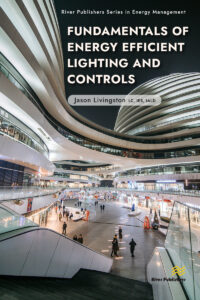
My New Book, Fundamentals of Energy Efficient Lighting and Controls, is Now Available

Cover of Fundamentals of Energy Efficient Lighting and Controls

I’m pleased and proud to announce that my new book, Fundamentals of Energy Efficient Lighting and Controls, is available for pre-order beginning today (March 13) and will begin shipping on April 3rd.

The book grew out of conversations with the Association of Energy Engineers and their need for better study material for their Certified Lighting Efficiency Professional (CLEP) exam.  This lead to an interesting observation: there are several good books aimed at educating future lighting designers (including my own Designing with Light) and several good books aimed at educating energy efficiency professionals, but none that address energy efficiency in lighting with an eye toward maintaining quality lighting design.  That is the goal of this book.

It is a comprehensive guide to quality, energy efficient lighting design and controls for commercial and institutional spaces. The text cover topics such as light sources and light fixtures, brightness and energy use calculations, financial analysis, light fixture maintenance, and auditing existing lighting systems.

As we all know, the introduction of LEDs and the phase out of traditional light sources, along with increasingly stringent energy codes, is leading to highly efficient lighting designs. This book places quality lighting design and consideration for the comfort of the occupants on an equal footing with energy efficiency to emphasize a holistic approach. With over a hundred high quality images and illustrations, Fundamentals:

  • Provides an overview of lighting design considerations and the design process.
  • Thoroughly covers light sources and lighting fixtures with an emphasis on LEDs.
  • Explains the requirements found in most energy conservation codes and voluntary programs including lighting controls, daylighting, and limits on lighting system power consumption.
  • Discusses non-design issues such as maintenance, energy audits, and the financial analysis of retrofit vs replacement options in existing buildings.

Fundamentals of Energy Efficient Lighting and Controls is available from Amazon, Barnes & Noble, Routledge, and other online retailers.

How are CCT and Duv Calculated? IES TM-40

If you look up the definition of Correlated Color Temperature (CCT) in IES LS-1 you’ll find, “The absolute temperature of a blackbody whose chromaticity most nearly resembles that of the light source.”  It seems straightforward.  The spectra of non-incandescent light sources don’t exactly match a blackbody radiator.  They’ll plot off the blackbody locus in a chromaticity diagram.  A CCT calculation identifies the color temperature closest to the light source in question – that’s the CCT.  We all know that.

Not long ago someone on the IES Color Committee suggested that we develop and issue a standardized CCT calculation.  My first thought was, “What?  Are you saying that after decades of specifying CCT there’s no industry standard calculation method?  What’s going on?”  It turns out that since the late 1930s at least a dozen CCT calculation methods have been developed but none of them have been adopted by a standards setting body like the IES or CIE.   The same is true for Duv, the direction and distance between the chromaticity coordinates of the light source and the nearest point on the blackbody locus.  This means that the method used is up to the LED or equipment manufacturer, and can vary from one manufacturer to another.

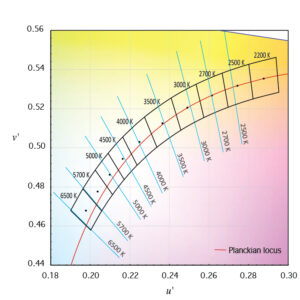
Now, for lighting designers this isn’t a problem.  Variations between the calculation methods generally aren’t large (although they can range from less than 1/1000th to several hundred K), and we are selecting LEDs described by their nominal CCT as outlined in NEMA C78.377, not their exact CCT.  Those chromaticity quadrangles are huge, roughly 400 – 500 K wide and over 7 MacAdam ellipses, as shown below. For lighting designers the problem is the huge variation possible within a single CCT designation, but that’s for another day.

C78.377 chromaticity quadrangles
NEMA C78.377 Chromaticity Quadrangles for LEDs

But, for LED manufacturers, testing equipment manufacturers, and researchers this can be a real problem.  If two people attempt to precisely measure the same LED and arrive at two different CCTs how would they determine who’s right, or which calculation is “better”?

Now we have an answer.  ANSI/IES TM-40 IES Method for Determining Correlated Color Temperature (CCT) and Distance from the Planckian Locus of Light Sources describes a CCT calculation method with an error of less than 0.1 K that calculates Duv based on the result of the CCT calculation.  While there’s no way to compel anyone to use this method, it is an American National Standard developed under the ANSI process, making it the closest thing we have to an industry standard.  Finally.

Retail Design Institute Lighting Summit

On Wednesday, September 25th I’ll be on a panel at the Retail Design Institute New York Chapter’s Lighting Summit 2024.  The other panelists are Shoshanna Segal of Hantranft Lighting Design, Carlotta Dove of IA Interior Architects, and Kazumi Tanimura of Atelier Lumiere.  The event is at the Illuminations showroom at 5 Penn Plaza.  Hope to see you there!

Healing Light at AIA New York

It’s been a while since I’ve posted anything because I’ve been working on a new book.  More on that as we get closer to the publication date.  Meanwhile, I’ve been asked (somewhat at the last minute) to speak on Monday June 3rd at an upcoming AIA New York event called Healing Light: The Biological and Social Effects of Lighting.  The presentation will be an introduction to color temperature and color rendering and is primarily targeted at architects and interior designers who are new to lighting.  Registration is free to AIA members and students, and only $10 for the general public.

Upcoming TM-30 Presentations

I’ll be giving two presentations in the next month.

On September 8th I’ll be giving an online presentation to the Raleigh Section of the IES.  Simplifying, Understanding, and Applying IES TM-30 will be from 12:30 to 1:30 eastern.  I’m going to set aside the color science that normally opens a TM-30 presentation to make more time for Annex E and the PVF specification system.  Admission is free.  Register here: https://www.eventbrite.com/e/simplifying-understanding-and-applying-ies-tm-30-tickets-695339287527?aff=oddtdtcreator

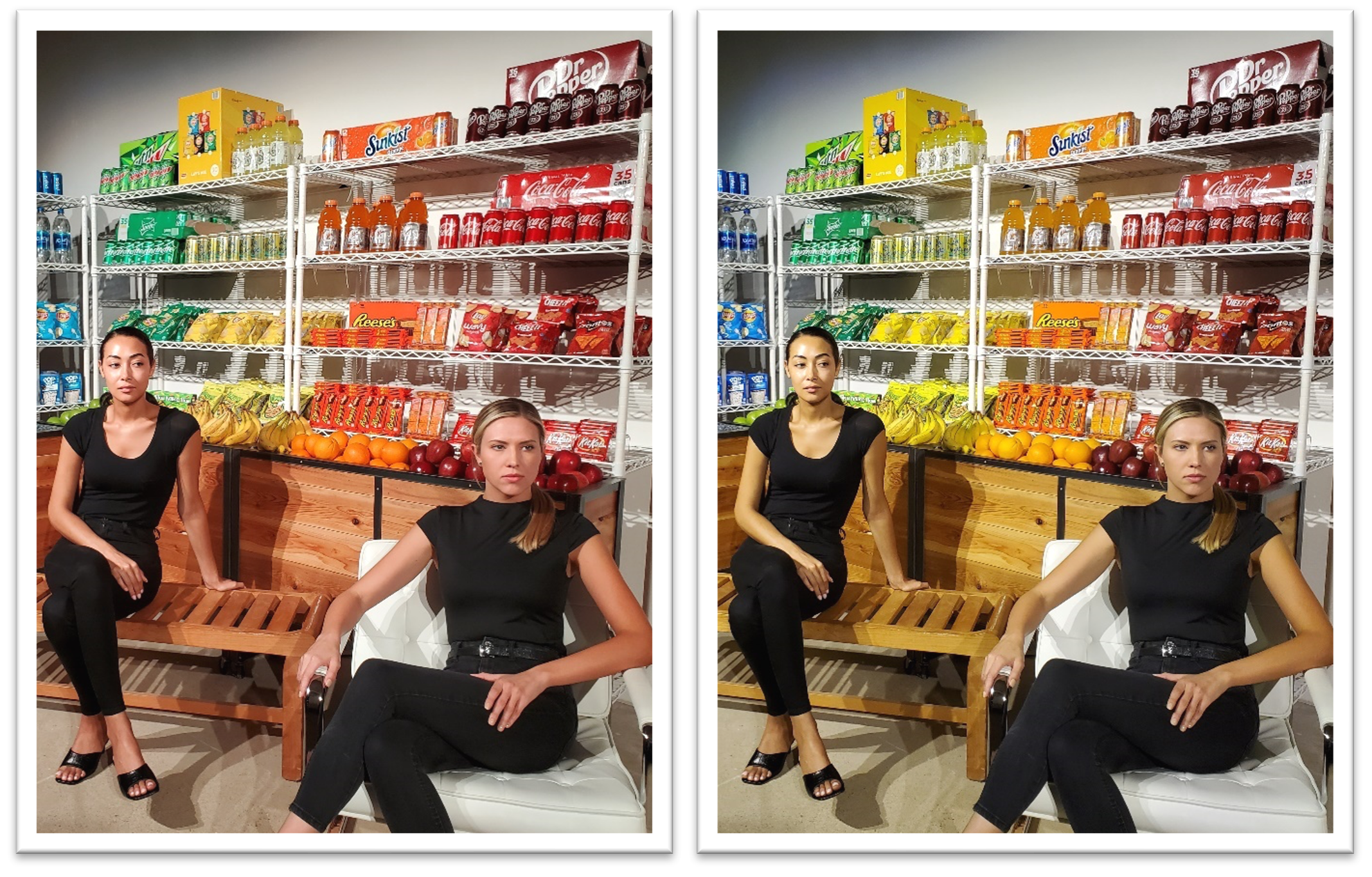
On September 19th and 20th Tony Esposito and I will be presenting Designing with TM-30, our third TM-30 presentation at ArchLIGHT Summit in Dallas, TX.  This 90 minute presentation starts with Tony talking about color science as it applies to TM-30, then I discuss integrating TM-30 into the lighting design workflow, and we wrap up with a 30 minute demonstration of TM-30s capabilities with the best mockup I’ve ever seen (see below for  Tony’s photos of last year’s mockup).  Register here: https://archlightsummit2023.sched.com/

TM-30 demonstration showing how varying the SPD, even within a single CCT, affects color appearance.

Back to Basics with ALA

On August 16th I’ll be giving a presentation for the American Lighting Association (ALA) called Back to Basics: Fixtures, Spacing, and Techniques.  Here’s their description.

This course will provide an introductory level overview of common fixture types and how they should be spaced/installed. Downlights, wall washers, wall grazers, under shelf, track lighting, LED fixtures, and small size LED fixtures. Learn with the use of drawings/renderings of proper spacing ratios and angle of focus as well as other critical information. This is a can’t miss information for lighting designers, sales professionals, and installers.

The presentation is online at 12 noon, eastern.  If you’re interested you can sign up here.